
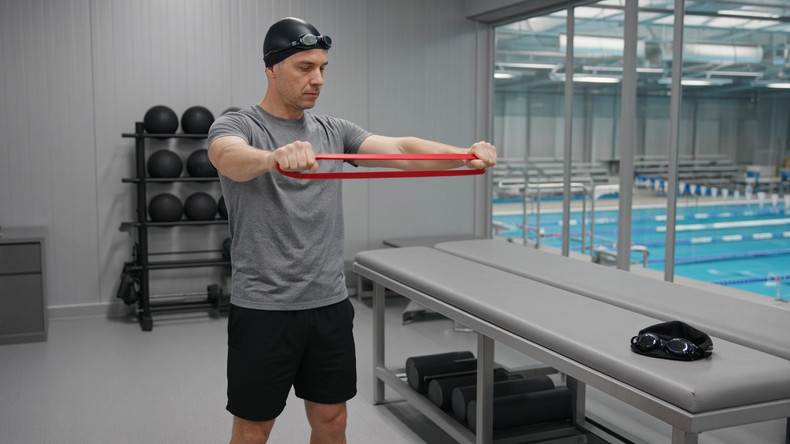
Swimmers spend hours in the water, but a lot of the speed in a race comes from things the pool alone doesn't train well: a powerful push off every wall, an explosive start, a body line that stays tight when you're tired, and shoulders that hold up through heavy yardage. Dryland training is where you build those. Done well it's short, specific and easy to recover from. Done badly it's a random circuit that leaves your shoulders cooked before warm-up.
This guide brings our earlier dryland articles together in one place. It covers what dryland should do, a drill menu sorted by purpose, a three-day weekly routine, how to fit it around pool training, and how to adjust it for sprinters, distance swimmers, age-groupers and masters. It doesn't replace pool skill work or a coach's eye. If a drill bothers your shoulder, neck or lower back, stop and have a qualified coach or clinician look at it.
What dryland is for
Water gives you nothing to push against except at the start and the walls. Most of your propulsion comes from the lats and trunk, the legs add speed, and the shoulder is the hinge everything passes through. That shapes what land work should do. Every drill should do at least one of these four jobs:
- Teach a position you need in the water: a tight streamline, a stacked body line, a good kick shape.
- Build strength or power that shows up in the race: starts, turns and the late-race pull.
- Prepare the shoulders and upper back to handle the training volume.
- Train the trunk so force from the legs actually reaches the hands.
If a movement is hard but does none of those jobs, it's just fatigue, and swimmers already get plenty of that in the pool.
The drill menu
Body line and core
- Streamline hold against a wall: stand with your heels, hips, upper back and hands touching the wall, ribs down, arms squeezed behind the ears. Hold 15–20 seconds, 3–4 times. It teaches the position you want off every wall.
- Hollow body hold: lie on your back, press your lower back into the floor, lift your arms and legs. Bend your knees if your back arches. Do 3 sets of 20–30 seconds.
- Dead bug and side plank: short, high-quality sets beat long, fading planks. Do 2–3 sets of 6–8 slow dead bug reps per side, and side planks of 20–30 seconds.
- Flutter kick plank: hold a plank and alternate small leg lifts from the hip, 3 sets of 20–30 seconds. It builds kick endurance while the trunk stays still.
Pull, posture and shoulder care
- Band pull-aparts and face pulls: 2–3 sets of 12–15 light, crisp reps on most dryland days. They keep the shoulder blades moving so the stroke doesn't hang on the front of the shoulder.
- Band external rotation: elbow tucked to your side, rotate out slowly, 2–3 sets of 15. Freestyle and butterfly train the internal rotators hard, and this balances them.
- Light Y-T-W raises: face down, thumbs up, small range, no swinging. This is for posture and control, not a burn.
- Lat pulldown, pull-up or inverted row: 3–4 sets of 6–10, pulling to the upper chest with the shoulders down and away from the ears. These train the main muscles of the underwater pull.
- Push-up progression: keep the body rigid and stop when the line breaks. Raise your hands on a bench if a full push-up falls apart.
Legs and power for starts and turns
- Streamline squat jump: arms locked in streamline, squat and jump, then land quietly and stacked. Do 3–4 sets of 3–5. A few crisp jumps beat fifty sloppy ones. If you can't land well yet, use goblet squats until you can.
- Hip hinge: with a dowel, kettlebell or light trap bar, 2–3 sets of 6–8 smooth reps. Turns and the kick both need hips that load and extend.
- Split squat or step-up: 2–3 sets of 6–8 per leg, for the one-leg load of a track start and for balanced legs.
- Single-leg balance with a slight hinge: 20–30 seconds per side, 2–3 rounds.
- Ankle rocks and slow calf raises: a stiff ankle changes the kick. Do 2 easy sets.
- Medicine-ball chest pass or rotational throw: 3 sets of 4–6 fast reps. Low volume, high intent.
A three-day weekly routine
Each session takes about 30–40 minutes. Start with 3–5 minutes of easy movement: jumping jacks, arm circles, 10 band pull-aparts, 10 scapular push-ups and 10 bodyweight squats. Finish with the mobility block below.
| Day | Focus | Exercises |
|---|---|---|
| Day 1 | Shoulders and upper back | Pulldown or pull-up 4×6–8; inverted row 3×8–10; band external rotation 3×15; face pull 3×12–15; push-up progression 3×6–10 |
| Day 2 | Core and body line | Hollow hold 3×20–30 s; dead bug 3×6/side; side plank 2×20–30 s/side; flutter kick plank 3×20–30 s; streamline wall hold 3×20 s |
| Day 3 | Legs and power | Streamline squat jump 4×3–5; goblet squat or hinge 3×6–8; split squat 3×6–8/leg; med-ball throw 3×5; calf raises 2×12 |
Two days instead of three: most school-age and club swimmers who already swim several times a week do well with two. Put the legs and power work with a hinge and core on one day, and the shoulder, row, push-up and throw work on the other.
Mobility to finish every session (5 minutes): doorway chest stretch, lat stretch on a bench, thoracic extension over a foam roller, and gentle ankle mobility. Keep a full range of motion in every pulling exercise so strength never costs you flexibility. Getting so strong that you lose shoulder mobility is the most common way dryland goes wrong.
Fitting dryland around pool training
- Right before a swim: keep it light. Band work, core holds and a few streamline jumps prime you without wrecking the session.
- After a swim or on a separate day: this is where the heavier strength and power work goes.
- Spread it out: leave at least a day between dryland sessions when you can. Don't stack a high-volume jump day on the same afternoon as a big kick set.
- Meet weeks: drop the jumps and heavy sets. Keep only easy shoulder work and body-line holds.
Adjusting by swimmer
Sprinters get the most from power: jumps, throws and heavier, lower-rep pulls. Distance swimmers lean toward higher-rep core and shoulder endurance work with less heavy loading. Age-group swimmers can do almost all of this with bodyweight and bands, ideally with a coach watching technique. Masters swimmers should put shoulder care and trunk stability first and add load slowly, since dryland also helps hold on to muscle as you age. Every group gets something from the streamline squat jump, because starts and walls are free speed.
What to skip
- Only training the "show" muscles: heavy bench press and curls do little for the stroke. Prioritize the upper back and rotator cuff.
- Heavy overhead pressing by default, especially when the shoulders are already tired from pulling.
- Punishment circuits after a hard practice "because we have to do dryland."
- Long runs that leave you stiff for the next swim, unless your coach has a specific reason for them.
- Ignoring pain: pain that lingers after practice, pinching when you reach overhead, or a sudden drop in stroke length are reasons to back off and see a coach, physio or doctor, not to push through.
Recovery and fuel
Heavy yardage plus dryland adds up. Eat a carbohydrate-rich snack after morning practice, protect your sleep around early starts, and do a few minutes of chest and lat stretching every day. You sweat in the pool even though you can't feel it, so drink water through practice.
Common questions
Will dryland make me bulky and slow? Not with a program like this. Moderate strength and power work supports speed. Bulk mostly comes from very high-volume bodybuilding training combined with a large calorie surplus.
Can young swimmers do dryland? Yes. Bodyweight exercises, band work and core holds are a good starting point for age-group swimmers, with a coach supervising technique.
How soon will I notice a difference? It varies. Most swimmers who stay consistent for a couple of months notice better walls and a steadier body line first.
Where to go next
For a written season plan with progressive dryland phases, shoulder care and taper guidance, start with Swimming Performance Foundations (Tier 1), or browse the full swimming training guides. Not sure which level fits? Take the free Find Your Program quiz.
This article is general education, not medical advice. Check with a physician before starting a new exercise program.