
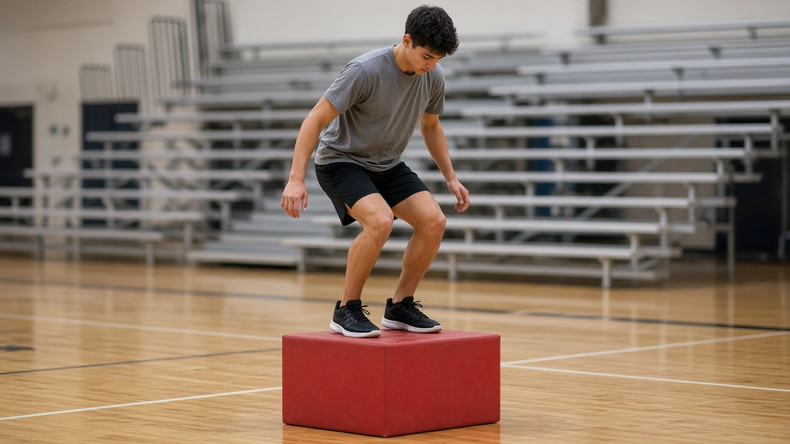
A higher vertical comes from three things: stronger legs and hips, the ability to use that strength quickly, and landings good enough that you can keep training. There's no single "jump trick" that replaces them. Adding hundreds of random jumps a day usually does more harm than good, because basketball practice already gives your knees and ankles plenty of jumping.
This guide replaces our two earlier basketball jump articles. It's an eight-week plan for high-school and rec players, plus parents and coaches who want a clean starting point. It covers the training, the landing work that keeps you healthy, how to fit it around practice and games, and how to measure progress honestly. It isn't medical advice. If you have knee, hip or ankle pain or a recent injury, get cleared before you add plyometrics.
What actually raises a vertical
A jump is force pushed into the floor, quickly, with the right joints stiff and enough mobility to get into a good position. So the training has four parts:
- Strength: a squat pattern, a hip hinge and a single-leg exercise, about twice a week.
- Power: a small number of fast, crisp jumps or throws, done fresh and not after a 90-minute scrimmage.
- Landing: every jump is also a landing you have to absorb.
- Approach work: if you care about a running jump off one or two feet, you have to practice the approach, not just standing jumps.
Sleep and a sensible weekly jump count matter as much as the exercise list. A player who jumps in practice, then in games, then does a long plyometric circuit on top isn't grinding. They're piling up landings.
The eight-week plan
Train two days a week with at least one day between sessions. Each session starts the same way: easy skips, side shuffles, two hip openers, five bodyweight squats and two or three practice landings.
Weeks 1–3: build the base and own the landing
Day A
- Goblet squat: 3 sets of 6–8, slow on the way down
- Romanian deadlift (dumbbells or a light bar): 3 sets of 8
- Depth drop to stick: step off a low box (6–12 inches), land and freeze for two seconds. 3 sets of 4.
- Dead bug: 2 sets of 6 per side
Day B
- Rear-foot-elevated split squat: 3 sets of 6 per leg
- Step-up to a knee-height box: 2 sets of 6 per leg
- Squat jump to a quiet landing: 3 sets of 3
- Calf raises, slow: 2 sets of 12
Weeks 4–6: add load and speed
Day A
- Trap bar or goblet squat: 4 sets of 4–6. The weight goes up, but every rep still looks the same.
- Trap bar jump (light: about the bar plus small plates, or dumbbells at your sides): 3 sets of 3, landing soft
- Romanian deadlift: 3 sets of 6
- Box jump to a box you land on easily: 3 sets of 3, stepping down every time
Day B
- Single-leg box squat or rear-foot-elevated split squat: 3 sets of 5 per leg
- Medicine-ball scoop toss: 3 sets of 4, as fast as you can while staying clean
- Approach jumps to a landing (it doesn't have to be a dunk): 4–5 quality reps, with full rest between them
- Banded defensive slide: 3 sets of 15 feet each direction. It's not a jump drill, but it builds the hips that load your takeoff and protect your knees on cuts.
Weeks 7–8: sharpen, then test
Keep the same exercises, drop one set from each strength exercise, and keep the jumps at 3–4 sets of 2–3 at full intent. You should finish each session feeling fresher than when you walked in. At the end of week 8, re-test (see below).
The landing checklist
A higher jump is wasted if you can't absorb the landing. Before you add height or reps, check these four things. Film two or three landings from the front and the side.
- Quiet feet: a loud slap means you're crashing instead of absorbing.
- Knees track over the middle of the foot: they shouldn't dive inward.
- Hips sit back and help instead of landing stiff and straight-legged.
- Chest up, eyes forward, balanced enough to hold the position for two seconds.
If one knee caves in, lower the box, slow the reps down and add a set of split squats until the pattern cleans up. Teen players working on this should also read our teen basketball landing mechanics drills.
Count your jumps
Practice and games are already jump-heavy. Use a simple rule: if practice was jump-heavy, cut the plyometric sets in half that day. On game days, skip the training jumps or keep only a few easy ones in warm-up. Don't lift heavy the morning of a game. During a long tournament weekend, the weight room should be about mobility and recovery, not new jumps.
Conditioning without losing your legs
Court sprints (suicides) build the late-game engine, but do them on a separate day or at the end of a light session, not before your jump work. Fatigue makes landings sloppy, and sloppy landings are where knees get irritated.
Measuring progress honestly
Test every six to eight weeks under the same conditions: same shoes, same floor, same warm-up, and the same type of jump (standing or approach, clearly defined). Use the best of three attempts. The athletic performance calculator can help you turn your number into a training zone and a near-term goal.
Expect results to vary. A player who has never lifted and lands poorly often sees a noticeable change after a couple of months of consistent strength work. A player who already lifts and jumps a lot may be chasing a smaller gain over a longer block. Anyone promising ten inches in thirty days is selling a shortcut, not a plan.
What to skip
- Depth jumps off a high box before you can land a small jump well
- Daily "100 jumps for a bigger vertical" challenges
- Jump training stacked on the same day as a hard practice with lots of jumping
- Ignoring the trunk. You still need a strong core and shoulders you can trust on contact. This just isn't a bench-press program.
Can I do this at home?
Yes, to start. Goblet squats with a dumbbell or a loaded backpack, split squats on a couch, a hinge with whatever weight you have, and a few quiet squat jumps on a forgiving surface will cover weeks 1–3. You don't need a gym to begin. You do need clean landings.
Quick questions
Should I do plyometrics every day? No. Most players already jump a lot in practice. Two short, high-quality sessions a week are enough, and more than that usually just adds soreness.
Do ankle weights or weighted vests help? Don't jump in ankle weights. They change your mechanics and load the knee and hip awkwardly. A light trap bar jump, loaded through the hips and trunk, is the safer way to add resistance to a jump, and only once your landings are clean.
What about in season? Keep one strength day a week with lower volume (two sets per exercise) and a handful of jumps. The goal in season is to hold on to what you built, not to chase a new max.
Want it written out for you?
For a full beginner basketball program with strength, jump and conditioning progressions, start with Court Foundations – Basketball Fitness (Tier 1), or browse all basketball training guides. Players aged 13–17 can also look at the teen basketball series.
This article is general education, not medical advice. Check with a physician before starting a new exercise program.