
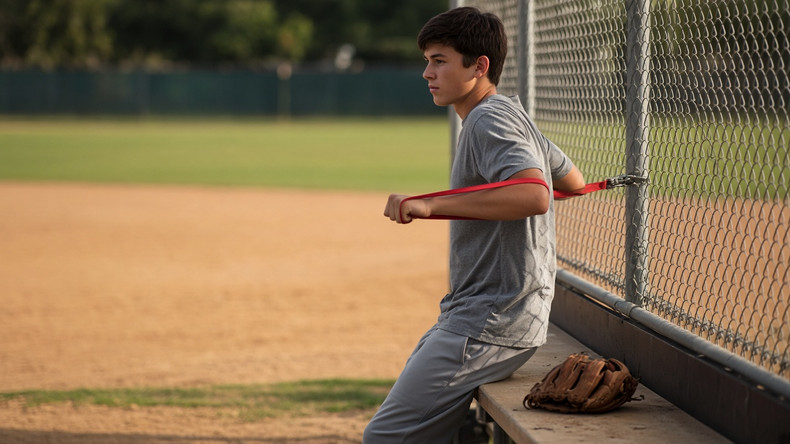
Baseball arm care isn't a magic warm-up you do once in March. It's a short, regular routine that gets the shoulder and elbow ready to throw and helps them settle down afterward. It won't add velocity on its own. What it does is keep you available, and staying available is the only way velocity, command and a long season happen.
This guide combines our earlier adult and youth arm care articles into one reference for pitchers, catchers and position players of every age, with a dedicated section for parents and coaches of young players. It's general education, not medical advice. If you have sharp pain, numbness or tingling, a sudden loss of speed or control, or pain that's still there at the next outing, stop throwing and see a qualified medical professional.
Workload comes before any routine
No band series can make up for overuse. These rules matter more than anything else in this article:
- Follow pitch count and rest guidelines for your age. MLB and USA Baseball publish age-based limits and required rest days through Pitch Smart. Treat those numbers as a ceiling, not a target, and count pitches across every team a player is on.
- Don't throw hard on a tired arm. A tired or heavy arm is a stop sign.
- Take real time off from throwing each year. Youth guidelines recommend several months a year with no competitive pitching.
- Avoid pitching and catching in the same game. Catchers throw constantly, so the workloads add up fast.
- Never throw through pain in the shoulder or elbow.
What a good routine includes
- Whole-body warm-up: you throw with your legs and hips, so wake them up too.
- Shoulder-blade activation: so the shoulder blade slides and supports the arm instead of shrugging.
- Rotator cuff activation: light work so the small stabilizers are switched on before you throw.
- A gradual throwing build-up matched to the type of day.
- A short reset afterward and a plan for the next day.
What it isn't: a 45-minute workout that leaves you tired before catch play, or a substitute for rest days and whole-body strength training.
The routine by type of day
Throwing day (10–15 minutes before catch play)
1. Warm-up (2–3 minutes). Light jog, side shuffles and carioca for about 30 seconds each. Then 10 small and 10 large arm circles each direction, and 5 walking lunges with a twist per leg.
2. Band series (4–5 minutes) with a light band. Use a band you could pull for 12–15 smooth reps without swinging.
- External rotation, elbow pinned at your side: 10–12 per arm
- Internal rotation, same position: 10–12 per arm
- Band pull-aparts: 12, squeezing the shoulder blades with a quiet neck
- Band rows: 12
- Straight-arm "T" raises: 10, slow and controlled
3. Wrist and forearm (1–2 minutes). 15 wrist curls up and 15 down with a light ball or no weight, then 10 three-second ball squeezes.
4. Throwing build-up. Start close, around 30–45 feet, with easy throws. Move back and add effort over several minutes. Focus on stepping toward the target, turning the hips and following through. Finish at the distance and intensity that day is supposed to reach, and no further.
Bullpen or game day
Use the same routine with a longer, more gradual build-up, so the arm is fully loose before game-intensity throws. Position players need this too. A shortstop who skips arm care all week and then lets one fly from deep in the hole is asking his arm to do a pitcher's job with less preparation.
Day after a hard outing
This isn't automatically a no-arm day, and it isn't another hard throwing day. A light reset works well for most players:
- 5–8 minutes of easy band work and shoulder-blade activation
- Light movement for the hips and upper back
- No max-effort throws
- Full rest if the arm feels sharp, stays tight or just feels "not right"
Sleep, food and water do more on this day than another band circuit.
True rest day
Skip the routine entirely, or do a few easy movements if they help you feel better. More isn't automatically better. A 12-minute routine you actually finish beats a 40-minute program you abandon by May. Catchers and infielders who throw all week should treat midweek as if they've already pitched innings. Their arms keep count even when nobody writes it down.
Strength beyond the arm
The arm is the last link in a chain that starts at the ground. Strong legs, hips and trunk produce and transfer force, which takes some of the load off the shoulder and elbow. Two short sessions a week cover it:
- Young players (8–12): bodyweight squats and lunges, glute bridges, planks and side planks, push-ups, band rows and light medicine-ball throws, supervised by an adult who knows good form.
- Teens and adults: add goblet or trap bar deadlifts, split squats, single-leg Romanian deadlifts, rows and rotational medicine-ball throws. Do the throws before any heavy lifting, while you're fresh, and stop the set when they slow down.
Rotational power gets its own treatment in our core work for bat speed article.
Does arm care increase velocity?
Not directly. Velocity comes from the whole throw: legs, hips, trunk, timing and a strong, resilient arm. Arm care is the maintenance that lets you keep doing the strength work, sprint work and throwing practice that actually change velocity.
For parents and coaches of young players
Throwing is one of the fastest movements in sports, and young arms are still growing. Habits learned at 10, 11 and 12 can shape how healthy an arm stays for years.
- Keep a simple log of pitches and throwing days, especially if a child plays on more than one team.
- Make "my arm is tired" a normal thing to say, and praise smart decisions like stopping when tired as much as strikeouts. Many kids won't speak up unless they know it's okay.
- Encourage other sports. Many experts recommend multi-sport participation for young athletes. It builds overall athleticism and gives the throwing arm a break.
- Pitch selection: many youth organizations recommend that young pitchers focus on fastball and changeup command first. Follow your league's guidance and your coach.
- Protect sleep and meals. Kids recover mostly while they sleep, and regular meals with protein, fruit and vegetables support growth and training.
Warning signs that mean stop
Arm care is not a way to manage pain on your own. Stop throwing and get the arm checked by a qualified professional if you notice any of these:
- Pain on the inside of the elbow, or pain in the shoulder during or after throwing
- Numbness or tingling into the hand or fingers
- A sudden drop in velocity or loss of control that rest doesn't fix
- Pain or stiffness that's still there the next day, or that comes back every time you throw
- Changing your delivery to avoid discomfort, which is often the first sign a player is hiding something
A checklist for the bag
- Did I do my prep before I threw, not after?
- Did I treat today as the day it actually is (catch, bullpen or game) instead of a max-effort day?
- Did I do a light reset after a hard outing?
- Am I following rest rules, not just how I feel in the first inning?
- Is anything sharp, lingering or suddenly weaker? If so, I'm not throwing through it.
Training plans that include arm care
For a full program that combines arm care with lower-body strength, rotational power and speed, start with Diamond Foundations – Baseball Fitness (Tier 1). Parents of 8–12-year-olds can browse the youth baseball guides, and players aged 13–17 the teen baseball guides.
This article is general education, not medical advice. Check with a physician before starting a new exercise program.