
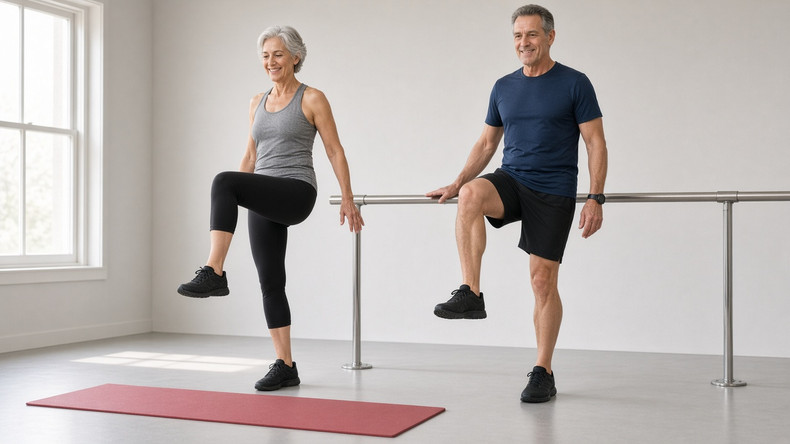
Balance is one of those abilities you don't think about until it slips. Then one day you notice you reach for the railing on the stairs, stepping into your pants takes a hand on the wall, or an uneven sidewalk makes you nervous. Like strength, balance tends to fade with age if you don't use it, and like strength, it improves when you train it. It takes a few minutes a day, little or no equipment, and a willingness to practice being slightly off balance in a safe way.
This guide is for adults over 50 who are generally healthy and want to stay steady and confident on their feet. It starts with simple self-checks, then gives a four-level progression you can follow at home. If you've fallen recently, feel dizzy, have numbness in your feet, or have a condition that affects balance, talk to your doctor or a physical therapist before starting. They can tailor a program to you.
Why balance changes, and why training helps
Staying upright depends on three systems working together: your eyes, the balance organs in your inner ear, and sensors in your feet, ankles and joints that tell your brain where your body is. Your muscles then make constant small corrections. With age, inactivity and some medications, any of these can become less sharp, and leg strength, especially around the hips and ankles, often declines too.
Balance training challenges all of these pieces at once. Combined with strength training for the legs and hips, it's one of the most practical things you can do to stay independent and active.
Set up safely first
- Practice next to a kitchen counter, a sturdy chair back, or in a corner where two walls meet, so support is always within reach.
- Clear the floor of rugs, cords and clutter.
- Wear supportive shoes at first. Barefoot work can come later on a safe surface.
- Rest a fingertip on the support whenever you need it. Using light support is part of the training, not cheating.
- Stop if you feel dizzy, lightheaded or unwell.
Three quick self-checks
Do these next to your support, and record the results so you can see progress in a month.
- Single-leg stand: stand on one foot with hands on hips. How many seconds can you hold it, up to 30? Test both sides.
- Tandem stance: place one foot directly in front of the other, heel touching toe, like standing on a tightrope. Can you hold it for 30 seconds?
- Chair stands: from a standard-height chair, arms crossed over your chest, how many times can you stand up fully and sit back down in 30 seconds? This checks leg strength, which supports balance.
There's no pass or fail. These are your starting numbers. If you can't hold a single-leg stand for even a few seconds, start at Level 1. If you can easily hold 30 seconds, start at Level 3.
The four-level progression
Practice five to ten minutes a day, most days of the week. Move to the next level when the current exercises feel steady and easy for a week or two.
Level 1: steady base
- Feet-together stand: stand with feet touching for 30 seconds, 2–3 times.
- Weight shifts: feet hip-width apart, slowly shift your weight side to side, then front to back, 10 times each.
- Heel raises at the counter: rise onto your toes and lower slowly, 2 sets of 10.
- Sit-to-stand: stand up from a chair and sit back down with control, using your hands if needed, 2 sets of 8.
Level 2: narrower base
- Tandem stance: 30 seconds per side, 2–3 times.
- Single-leg stand with support: one fingertip on the counter, 15–30 seconds per leg.
- Side leg raises: holding the counter, lift one leg out to the side and lower slowly, 10 per side.
- Sit-to-stand without hands: 2 sets of 8–10.
Level 3: less support, more movement
- Single-leg stand without support: 20–30 seconds per leg, hands hovering near the counter.
- Heel-to-toe walk: walk 10–15 steps along a hallway or counter, one foot directly in front of the other.
- Step-ups: onto a low, stable step, 2 sets of 8 per leg, holding a railing if needed.
- Clock reaches: stand on one leg and gently tap the other foot forward, to the side and behind, 5 rounds per leg.
Level 4: add challenge
- Single-leg stand with head turns: slowly look left and right while balancing.
- Single-leg stand with eyes closed: only next to support, for a few seconds at a time. Removing vision makes your feet and inner ear work harder.
- Walking with turns: walk, then turn 180 degrees on command and keep walking.
- Reverse lunges: holding support at first, 2 sets of 6–8 per leg.
- Standing on a cushion: a folded towel or firm pillow makes the surface less stable. Use it with support nearby.
Strength makes balance work better
Balance exercises teach control. Strength gives you the ability to recover when you do lose your footing. Aim for two strength sessions a week that train the legs and hips: squats or sit-to-stands, step-ups, glute bridges, side-lying leg raises and heel raises, plus some upper-body work. Our strength programs for adults over 50 build these in, and our daily 15-minute mobility routine pairs well with the exercises here.
Build balance into daily life
Some of the best practice happens outside a workout:
- Stand on one leg while brushing your teeth, switching halfway.
- Do heel raises while waiting for the kettle or microwave.
- Walk on varied surfaces like grass, trails and gravel paths when it's safe.
- Get up from the floor occasionally, using a sturdy chair for help if needed. Being able to get down and up again is a valuable skill.
- Try activities that challenge balance in a fun way: tai chi, yoga, dancing, pickleball or hiking.
A sample week
- Monday: 10 minutes of balance at your current level, plus a strength session
- Tuesday: balance practice built into daily tasks, plus a 20–30 minute walk
- Wednesday: 10 minutes of balance, plus mobility
- Thursday: balance plus a strength session
- Friday: 10 minutes of balance, plus an activity you enjoy like a tai chi class, pickleball or a hike
- Weekend: walk on varied ground, and do a short balance session on one of the days
Other things that affect your steadiness
- Vision: keep eyeglass prescriptions current and lighting good, especially on stairs and at night.
- Footwear: well-fitting shoes with good grip beat loose slippers.
- Medications: some can cause dizziness. If you notice changes, ask your doctor or pharmacist.
- Home setup: secure rugs, use night lights, and add grab bars or railings where they help.
How fast will I improve?
Many people notice they feel steadier within a few weeks of daily practice, and the self-check numbers usually improve with it. Re-test every four weeks. If you aren't improving, or balance seems to be getting worse, talk to your doctor or a physical therapist. A sudden change can have a medical cause worth checking.
Train with a plan
Our programs for adults over 50 combine strength, balance and mobility in a progressive weekly plan. See the Women 50+ guides and the Men 50+ guides.
This article is general education, not medical advice. Check with a physician before starting a new exercise program, especially if you have a history of falls or dizziness.